
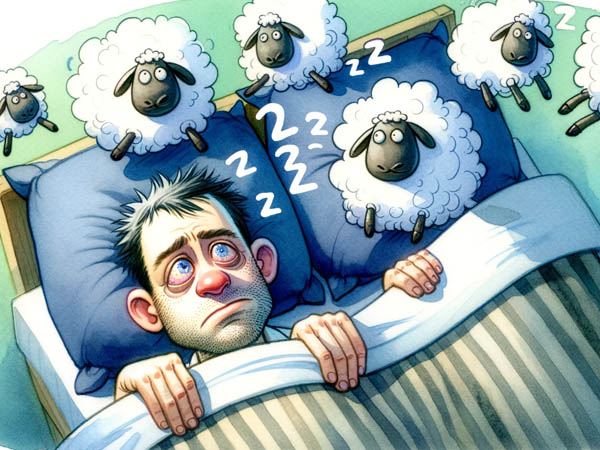

Conventional medicine has long relied on pharmaceutical sleep aids to treat sleep disorders. However, the use of natural sleeping pills, which include food supplements and herbs, is receiving a lot of attention due to their effectiveness and minimal side effects.
Sleeplessness, or insomnia, is a common sleep disorder affecting many people worldwide. It involves difficulty falling asleep, staying asleep, or experiencing non-restorative sleep, leading to daytime fatigue and other issues.
Insomnia affects between 10% and 30% of people, with some research suggesting that this figure could be as high as 50% to 60%
Fact 1 of 4
Symptoms
- Difficulty falling asleep
- Waking up frequently during the night
- Waking up too early and not being able to go back to sleep
- Feeling tired upon waking
- Daytime fatigue or sleepiness
- Irritability, depression, or anxiety
- Increased errors or accidents
Possible causes
- Stress: Concerns about work, health, finances, or family can keep the mind active at night.
- Travel or work schedule: Disrupting the body’s circadian rhythms (internal clock regulating sleep-wake cycle) can lead to insomnia.
- Poor sleep habits: Irregular bedtime schedule, naps, stimulating activities before bed, and an uncomfortable sleep environment can interfere with sleep.
- Eating too much late in the evening: Having a light snack is okay, but eating too much may cause physical discomfort while lying down.
- Mental health disorders: Anxiety disorders, such as PTSD (Post-Traumatic Stress Disorder), may disrupt sleep.
- Medications: Some prescription drugs can interfere with sleep.
- Medical conditions: Examples include chronic pain, cancer, diabetes, heart disease, asthma, gastroesophageal reflux disease (GERD), overactive thyroid, Parkinson’s disease, and Alzheimer’s disease.
- Sleep-related disorders: Sleep apnea (a condition where breathing repeatedly stops and starts during sleep) and restless legs syndrome (a condition causing an irresistible urge to move the legs) can lead to insomnia.
Statistics
- Numerous global studies[1] have indicated that insomnia affects between 10% and 30% of people, with some research suggesting that this figure could be as high as 50% to 60%.
- According to the American Psychiatric Association, about one-third of adults report insomnia symptoms, with 6-10% having severe enough symptoms to be diagnosed with insomnia disorder.
- A study[2] published in “Sleep Medicine Reviews” (2020) by Morin and Jarrin highlights that chronic insomnia can lead to increased risks of depression, anxiety, and substance abuse.
- The National Sleep Foundation’s Sleep in America poll (2006) found that among adolescents who frequently report feeling unhappy or tense, 73% believe they are not getting sufficient sleep at night, and 59% experience excessive sleepiness during the day.
Sleep Disorders in the Netherlands
In the Netherlands, a study[3] assessing the prevalence and characteristics of sleep and sleep disorders found that 32.1% of individuals reported a general sleep disturbance (GSD), and 43.2% reported insufficient sleep.
The prevalence rates for specific sleep disorders were as follows: 8.2% for insomnia, 5.3% for circadian rhythm sleep disorder, 6.1% for parasomnia, 5.9% for hypersomnolence, 12.5% for restless legs disorder and limb movements during sleep, and 7.1% for sleep-related breathing disorder.
Female adolescents had the highest prevalence rates for most sleep disorders, insufficient sleep, and daytime malfunctioning.
Women are twice as likely to suffer from insomnia compared to men.
Fact 2 of 4
Conventional treatments
Conventional treatments for sleeplessness, or insomnia, typically focus on addressing both the symptoms and underlying causes.
The primary approach often involves a combination of pharmacological and non-pharmacological therapies.
Pharmacological Treatments:
- Benzodiazepines: These sedative-hypnotic drugs, such as lorazepam and temazepam, are often prescribed for short-term management of severe insomnia.
However, they can lead to dependence and tolerance, so their use is generally limited. - Non-benzodiazepine Sedatives: Also known as Z-drugs, including zolpidem, zaleplon, and eszopiclone, are recommended for short-term treatment.
They are known for fewer side effects and lower risk of dependency compared to benzodiazepines. - Antidepressants: Low doses of certain antidepressants, like trazodone, are sometimes used to treat insomnia, especially when associated with depression[4].
- Melatonin Receptor Agonists: Drugs like ramelteon mimic the sleep-regulating hormone melatonin and are used to treat sleep onset insomnia.
Non-pharmacological Treatments:
- Cognitive Behavioral Therapy for Insomnia (CBT-I): This is a structured program that helps identify and replace thoughts and behaviors that cause or worsen sleep problems with habits that promote sound sleep. CBT-I is considered[5] the most effective long-term treatment for chronic insomnia.
- Sleep Hygiene Education: This involves teaching good sleep habits, like maintaining a regular sleep schedule, creating a comfortable sleep environment, and avoiding caffeine and electronics before bedtime[6].
Alternative and complementary treatments
A genome-wide analysis study on insomnia disorder revealed a link between insomnia and specific genetic variations located on chromosomes 7 and 9.
Fact 3 of 4
Food Supplements as Natural Sleep Aids
Melatonin
- Naturally produced by the brain’s pineal gland, melatonin regulates the sleep-wake cycle. Supplements of melatonin are often used to alleviate insomnia and ease jet lag symptoms.
- Research highlights melatonin’s effectiveness in significantly reducing sleep onset latency (time taken to fall asleep) and enhancing sleep quality.
A pivotal study[7] in “Neuroscience Letters” demonstrated that melatonin supplements decreased sleep onset time by about 7 minutes in adults with primary insomnia (Zhdanova et al., 2001). - Suggested Dosage: Typically, the adult dosage ranges from 0.5 to 5 milligrams, taken 30 minutes to an hour before sleep. For children, a lower dose of 0.5 to 3 milligrams is recommended. Consultation with a healthcare professional is advised.
Magnesium
- Magnesium, vital for over 300 enzymatic reactions in the body, is crucial in sleep regulation. A deficiency in magnesium is often linked to sleep disturbances.
- A 2012 study[8] showed that magnesium supplementation improved subjective insomnia indicators, sleep efficiency, and duration in older adults (Abbasi et al., 2012).
- Recommended Dosage: Daily magnesium intake varies by age and gender, typically ranging from 310 to 420 milligrams for adult men and 320 to 360 milligrams for adult women. Proper dosage should be determined under medical supervision.
Herbal Sleep Aids
Valerian Root
- Valerian is renowned for the sedative properties of its root, traditionally used to treat insomnia and anxiety. Key sleep-inducing components include valeric acid and various essential oils.
- A meta-analysis in “Sleep Medicine Reviews” affirmed[9] valerian root extract’s effectiveness in enhancing sleep quality without significant adverse effects (Fernández-San-Martín et al., 2010).
- Suggested Dosage: Valerian root extract is typically recommended in doses of 300 to 600 milligrams, taken 30 minutes to an hour before bed. Follow label instructions and consult a healthcare expert if necessary.
Chamomile
- Matricaria chamomilla, also known as Chamomile, is renowned for its calming and sleep-inducing effects. Apigenin, an active ingredient in chamomile, is known for its tranquilizing effect.
- A trial published[10] in the “Journal of Advanced Nursing” showed that chamomile extract reduced insomnia severity in older individuals (Zick et al., 2011).
- Recommended Dosage: Chamomile can be consumed as tea, capsules, or extracts. While there’s no precise dosage for tea, 1 to 2 cups daily is standard. Consult a healthcare professional for guidance on capsules or extracts.
Lavender
- Lavender, particularly its essential oil, is known for its relaxing properties conducive to sleep.
- A study found[11] that inhaling lavender oil before bedtime improved sleep quality and alleviated insomnia symptoms in students (Lewith et al., 2005).
- Suggested Dosage: Lavender oil can be used in various ways, such as diffusion, topical application, or in baths. While there’s no fixed dosage, follow product guidelines for safe application.
Sleep is one of the most vital activities for the human body, essential for regulating its functions.
Fact 4 of 4
Bibliography
- [1] Bhaskar S, Hemavathy D, Prasad S. Prevalence of chronic insomnia in adult patients and its correlation with medical comorbidities. J Family Med Prim Care. 2016 Oct-Dec;5(4):780-784. doi: 10.4103/2249-4863.201153. PMID: 28348990; PMCID: PMC5353813.
- [2] Morin, Charles M., et al. "Incidence, persistence, and remission rates of insomnia over 5 years." JAMA network open 3.11 (2020): e2018782-e2018782.
- [3] Kerkhof, G. (2017). Epidemiology of sleep and sleep disorders in The Netherlands.. Sleep medicine, 30, 229-239 . https://doi.org/10.1016/j.sleep.2016.09.015.
- [4] Jaffer KY, Chang T, Vanle B, Dang J, Steiner AJ, Loera N, Abdelmesseh M, Danovitch I, Ishak WW. Trazodone for Insomnia: A Systematic Review. Innov Clin Neurosci. 2017 Aug 1;14(7-8):24-34. PMID: 29552421; PMCID: PMC5842888.
- [5] Trauer JM, Qian MY, Doyle JS, Rajaratnam SM, Cunnington D. Cognitive Behavioral Therapy for Chronic Insomnia: A Systematic Review and Meta-analysis. Ann Intern Med. 2015 Aug 4;163(3):191-204. doi: 10.7326/M14-2841. PMID: 26054060.
- [6] Edinger, Jack D., et al. "Behavioral and psychological treatments for chronic insomnia disorder in adults: an American Academy of Sleep Medicine clinical practice guideline." Journal of Clinical Sleep Medicine 17.2 (2021): 255-262.
- [7] Zhdanova IV, Wurtman RJ, Regan MM, Taylor JA, Shi JP, Leclair OU. Melatonin treatment for age-related insomnia. J Clin Endocrinol Metab. 2001 Oct;86(10):4727-30. doi: 10.1210/jcem.86.10.7901. PMID: 11600532. https://pubmed.ncbi.nlm.nih.gov/11600532/
- [8] Abbasi B, Kimiagar M, Sadeghniiat K, Shirazi MM, Hedayati M, Rashidkhani B. The effect of magnesium supplementation on primary insomnia in elderly: A double-blind placebo-controlled clinical trial. J Res Med Sci. 2012 Dec;17(12):1161-9. PMID: 23853635; PMCID: PMC3703169. https://www.ncbi.nlm.nih.gov/pmc/articles/PMC3703169/
- [9] Fernández-San-Martín MI, Masa-Font R, Palacios-Soler L, Sancho-Gómez P, Calbó-Caldentey C, Flores-Mateo G. Effectiveness of Valerian on insomnia: a meta-analysis of randomized placebo-controlled trials. Sleep Med. 2010 Jun;11(6):505-11. doi: 10.1016/j.sleep.2009.12.009. Epub 2010 Mar 26. PMID: 20347389. https://www.sciencedirect.com/science/article/abs/pii/S1389945710001000
- [10] Zick SM, Wright BD, Sen A, Arnedt JT. Preliminary examination of the efficacy and safety of a standardized chamomile extract for chronic primary insomnia: a randomized placebo-controlled pilot study. BMC Complement Altern Med. 2011 Sep 22;11:78. doi: 10.1186/1472-6882-11-78. PMID: 21939549; PMCID: PMC3198755. https://www.cochranelibrary.com/central/doi/10.1002/central/CN-00805711/full
- [11] Lewith GT, Godfrey AD, Prescott P. A single-blinded, randomized pilot study evaluating the aroma of Lavandula augustifolia as a treatment for mild insomnia. J Altern Complement Med. 2005 Aug;11(4):631-7. doi: 10.1089/acm.2005.11.631. PMID: 16131287. https://citeseerx.ist.psu.edu/document?repid=rep1&type=pdf&doi=428f95bc0c05a68b01d60473df3cdb11c1eda410